Contract Farming
Contract Farming
Shasha Tobacco operates a FLUE- CURED VIRGINIA (FCV) tobacco contract program in Zimbabwe. Shasha Tobacco values all its growers, we endeavor to assist them in value addition and financial freedom. Our agronomy team seek out and sign legally binding contracts with identified potential growers through a thorough vetting procedure. Shasha Tobacco agrees to provide all the necessary inputs, technical services, the transportation of inputs to their farm and the option of transporting their FCV tobacco to the market at a reasonable fee. In return our growers with the assistance of our knowledgeable agronomy team are expected to grow FCV tobacco according to good sustainable agriculture practices. Our tobacco program is of a high ethical standards. We ensure that all our growers are following the TIMB Agriculture labor Practices (ALP) code, which bans the use of child labour in tobacco production amongst other practices. Our expert leaf techs regularly conduct farmer training sessions along with scheduled visits to each grower to ensure they are using environmentally friendly farming methods in the growing and curing of their tobacco. Our tobacco contract scheme constitutes of small scale growers, who make up 70 % of the scheme and also constitutes of medium to commercial growers who make up for the remaining 30% of the scheme.
Good Agricultural Practical
Good agricultural practices (GAP) are a set of standards, guidelines and principles which are implemented in agriculture to promote the safety of the environment, sustainability of crop production and improve the welfare of people involved in agriculture as well as the safety of consumers of agricultural products. Good agricultural practices encompass a wide range of subjects,which includes of Agriculture Labour practices (ALP), Sustainable tobacco programme (STP) and Non – Tobacco Related Material (NTRM).
Our Capabilities
- GPS Fleet Tracking
- Goods In Transit Insurance
- Expert Agronomy Team
- Modern Fleet
Partner with Shasha Tobacco
Tobacco Production Timeline
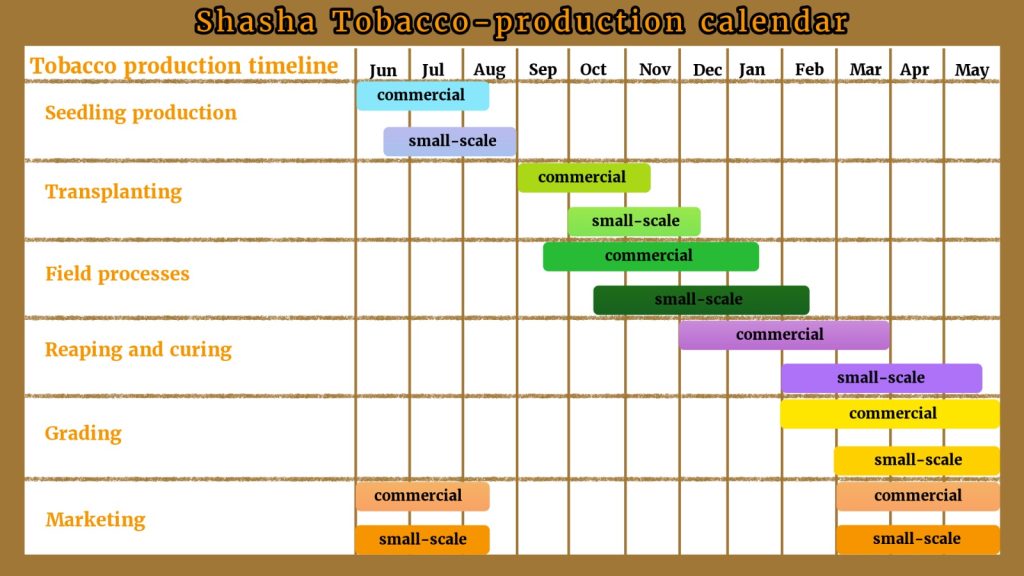
Large-scale commercial and small-scale tobacco growers follow different production timelines, although there are some operations that overlap. As summarized in the table above, the production cycle occurs in the following sequence:
Seedling Production
Tobacco seedling production begins on 1 June each year, which is legislatively the first day of sowing. Large-scale commercial growers begin sowing in June for their irrigated crop, while small-scale growers may begin seedbed preparation as early as mid-June, although most do so in July and into August.
Transplanting
Transplanting for irrigated tobacco begins on 1 September each year, which is legislatively the first day of transplanting. Small-scale growers begin transplanting in October for those who use water-planting, while those relying on rain-fed production usually wait for the onset of rains in late October to early November.
Field Management
Field management activities, including fertilizer application, weeding, topping, and de-suckering, are carried out within three months of transplanting, after which reaping and curing begin. December 31 of each year is regarded as the last day for seedbed destruction.
Reaping and Curing
Reaping and curing for the September-irrigated crop typically begin in December, while reaping and curing for small-scale crops usually begin at the end of January. For commercial crops, reaping and curing generally run from December to March, whereas for small-scale crops, they extend from January to May.
Grading
Grading for commercial growers usually takes place from February to May, while for small-scale growers, it runs from March to May. May 15 of each year is the last day for tobacco stalk destruction. The marketing season runs from March to July or August, with the opening and closing dates of the sales floor regulated by the Tobacco Industry and Marketing Board (TIMB).
Driven by Sustainable Innovation.
Trusted by Modern Farmers
Why Choose Us
Why Choose Shasha Tobacco
We combine ethical farming, sustainable practices, and global expertise to deliver premium FCV tobacco and lasting grower partnerships.